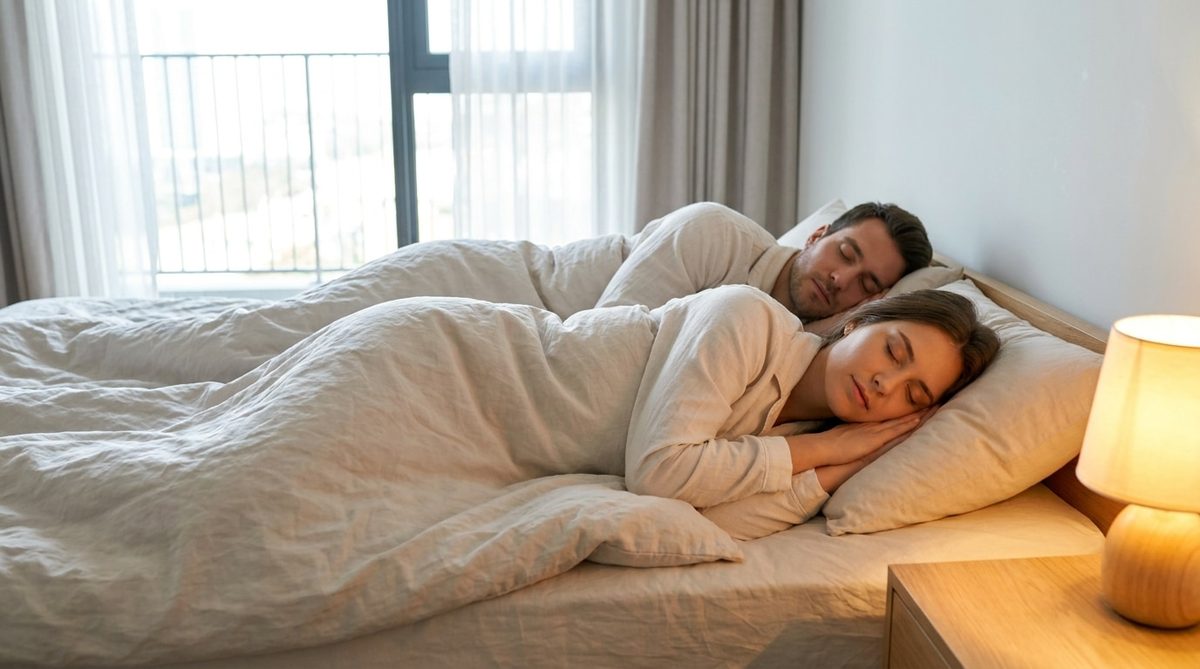
We’ve all been fed the same romantic lie. You know the one. It’s the image of couples curled together in perfect, spoon-like unison, an inseparable unit even in sleep. It’s a beautiful fantasy. It’s also statistically unlikely and often physically miserable.
When summer hits, the heat becomes a non-negotiable fact. You sweat. You toss. You turn. And suddenly, you’re facing the wall while your partner faces the other side.
Panic sets in. A little alarm bell rings in your head. Is this it? Are we drifting apart? Does turning my back mean I’m rejecting them emotionally?
It’s a common trap. We mistake physical distance for emotional abandonment. But the science says otherwise. In fact, sleeping back-to-back might be the ultimate sign that your relationship is stable, secure, and thriving.
The Myth of the Fusion Couple
Our culture loves the idea of the “fusion couple.” The belief that true love means being physically connected at all times. Even at night. Even when you need to regulate your own temperature.
This expectation creates unnecessary anxiety. When you wake up and realize you’re no longer spooning, it feels like a failure. You start questioning the flame. You wonder if routine has built a wall.
But here’s the truth. You don’t need to touch every millimeter to prove you care.
In the early stages of a relationship, that constant contact makes sense. It’s about security. It’s about closeness. But as a bond deepens, the need for that physical validation shifts. It doesn’t disappear. It matures.
Sleeping in opposite directions isn’t a rejection. It’s a sign of immense trust. It means you’re comfortable enough in your own skin and in your partner’s presence to let go of the need to hold on for dear life. It’s an affirmation of autonomy. You know they’re there. You know they’re committed. You don’t need to physically restrain them to feel safe.
The Science of Separation
Researchers have looked at this. They’ve studied couples who sleep apart, or who simply prefer more space. The findings are consistently reassuring.
- Better Sleep Quality: When you’re not contorting your body to accommodate someone else’s limb placement, you sleep deeper.
- Less Restraint: Constant touching can restrict movement. Turning your back allows for free movement.
- Individual Comfort: Everyone has a preferred sleeping position. Respecting that is a form of love.
The “back-to-back” position, often called the free side or solitary side in sleep studies, is linked to higher relationship satisfaction in long-term couples. Why? Because it balances intimacy with independence.
The Secret Handshake: Why Contact Still Matters
Here is where the magic happens. Most couples who sleep back-to-back aren’t completely separated. They’re often touching.
It’s subtle. Maybe it’s a foot brushing against a leg. Maybe a shoulder blade presses lightly against another. Or perhaps hands meet in the middle of the mattress.
This small point of contact is critical. It’s the “umbilical cord” of modern romance. It says, I am close. I am available. I am yours.
But it also says, I am resting. I am independent. I trust you.
“The back-to-back position with slight contact translates to comfort and emotional security, not distance.”
This is the sweet spot. You get the restorative power of individual sleep space. You get the psychological comfort of knowing your partner is right there. You don’t have to choose between autonomy and affection. You can have both.
Breaking the Romantic Script
It’s time to let go of the spooning mandate. If you’re turning away from your partner because it’s hot, or because you’re a restless sleeper, or simply because it feels better—it’s not a crisis. It’s evolution.
A healthy relationship doesn’t require you to merge into one entity 24/7. It requires you to respect each other’s needs, even when you’re unconscious.
So, next time you wake up and find your back facing theirs, don’t panic. Don’t assume the worst. Instead, look for that small point of contact. A toe. A hand. A hip.
Feel that connection. It’s not fading. It’s just changing shape. And honestly? It’s probably more comfortable for both of you.
There’s a freedom in that. A quiet, unspoken agreement that says you don’t need to perform intimacy to prove it exists. You just need to be there. And breathe. And sleep.