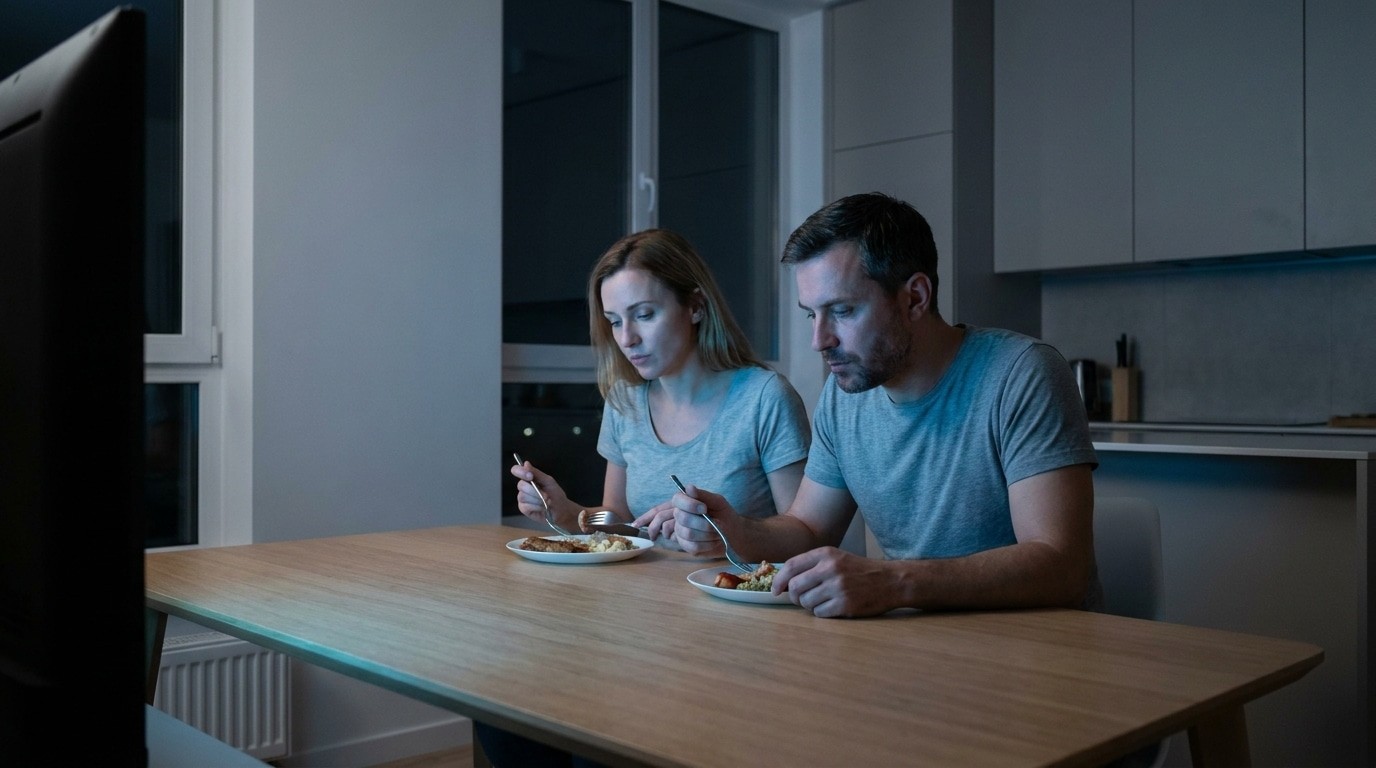
It is 7 PM. You are exhausted. The day was long, the emails were endless, and your brain feels like it has been run through a blender. So you slump onto the couch. A plate of food balances precariously on your knees. The remote is in your hand. You queue up the next episode of that show everyone is talking about.
Silence falls.
It only breaks for the dialogue on screen and the soft clatter of a fork against ceramic. It feels innocent enough, right? A well-deserved decompression after a hard shift. Couples often call it “me time” or “chilling out.” But underneath that comfortable surface, something is rotting. The dinner table used to be the heart of the home. Now, it is just a cold viewing booth.
What exactly are you losing when you choose the sterile comfort of the TV over the face of your partner? For many, the answer is bitter. The bond doesn’t snap. It doesn’t end with a shouting match or a slammed door. It just… erodes. Quietly. Invisibly.
The TV as an emotional wall
At first, turning on the TV seems like a practical solution. It is a buffer. A shield against the stress of the outside world. You tell yourself you need to switch off your brain. You need to stop thinking about work, about money, about the leaky faucet.
But the screen acts as a thick emotional paravent.
Under that artificial blue glow, the living room loses its warmth. It stops feeling like a home and starts feeling like a train station waiting area. Two people sit side by side. They are cohabiting, but they are not connecting. They are staring at a fixed point, waiting for something to happen.
There are no arguments. There is no conflict. So why does it feel so lonely?
Laughter at a comedy sketch gives the illusion of shared activity. It mimics cohesion. But cognitively, your empathy is gone. It has been hijacked by the fiction on screen. The person next to you becomes a cushion. A neighbor. Not an anchor.
You are missing the micro-connections
The speed of modern life tricks us into thinking big gestures matter most. We think love is built on anniversaries, grand vacations, or profound late-night conversations.
It is not.
Love is built on the tiny, invisible moments around a shared plate. A tired glance seeking comfort. A smile when a coworker did something stupid. A nod that says, I hear you.
These micro-connections are the mortar between the bricks of a relationship. Experts in couple psychology have noted a stark reality: meals without eye contact or verbal exchange strip away the daily maintenance required for intimacy.
When you fixate on a show, you starve the relationship of its most fertile ground. You are not preserving your energy. You are withholding attention. And attention is the currency of love.
When pixels confiscate these calibration moments, the emotional reserve of the home empties out. Drop by drop. Evening by evening. No alarms go off. The house stays quiet. The screen stays bright.
The cost of silent dinners
The damage does not stay in the living room. It follows you into the bedroom. It follows you into the kitchen. It follows you into your own head.
The prolonged absence of real contact creates a numbness. A disconnection that touches the core of your affection. Without the gentle transition of a real conversation at the end of the day, moving to the bedroom feels mechanical. Cold.
You begin to realize you do not know who this person is anymore. Not really. You don’t know their current fears. You don’t know how they have changed over the last six months of silent dinners. You don’t know what is happening in their head because you were too busy watching what was happening on the screen.
A chasm opens up. It is dug patiently, evening by evening, by the glow of the TV.
This leads to a specific kind of loneliness. The loneliness of being with someone you no longer know. It is a paradox that is hard to break once it sets in. Fixing it requires lucidity. It requires effort. It requires breaking the ice you helped create.
Reclaiming the evening
It is early summer. The evenings are long. The light is good.
There are natural opportunities to change this script. You can break the routine. You can leave the couch.
Try sitting at a table. Try sitting on a balcony. Try sitting on the floor if you have to. Get away from the screen. The TV is just a box of plastic and glass. Keeping it on by default is often just a lack of courage to restart a dialogue.
Why wait until the silence wins?
Turn off the TV. Look at your partner. Ask them how their day actually was. Not the summary. The real version.
The spark might be faint. It might take some rubbing to get it going again. But it is there. Or it isn’t. You won’t know until you stop looking away.