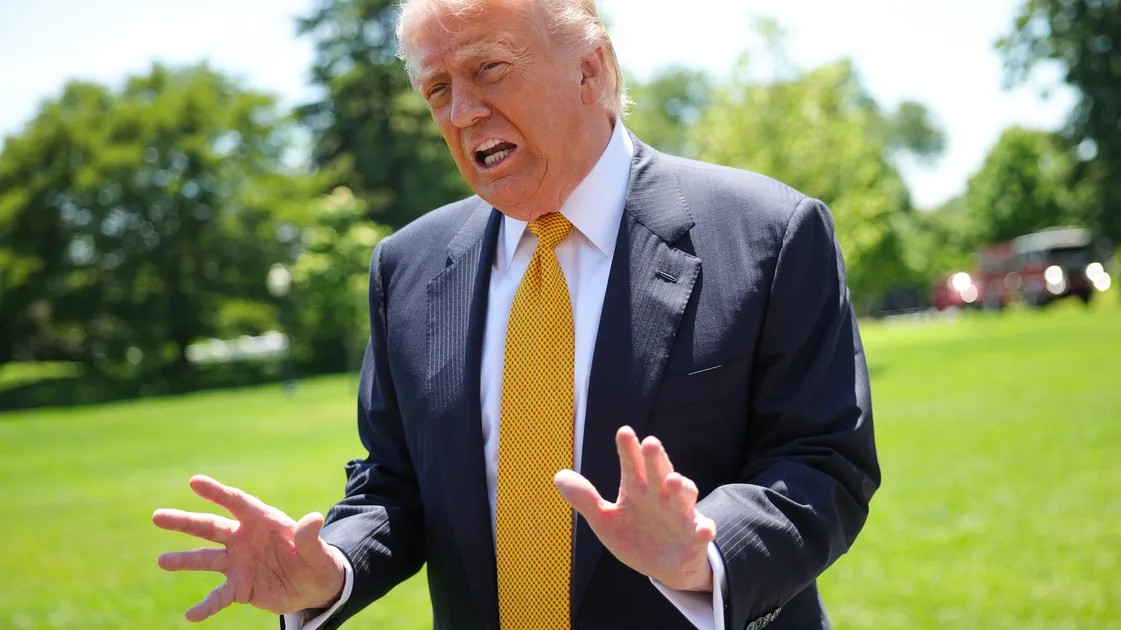
President Donald Trump has once again drawn sharp criticism for his treatment of the press, specifically targeting female journalists with personal insults during a recent press gaggle. In incidents involving reporters from MS NOW and ABC News, the President dismissed their questions as evidence of intellectual deficiency, labeling one a “dumb person” and another a “stupid person.”
These outbursts have reignited debates about press freedom, gender dynamics in political coverage, and the widening chasm between the White House and the media.
The Ballroom and Inflation: Questions Met with Insults
The confrontation began outside the White House when MS NOW reporter Akayla Gardner asked about the controversial renovation of the White House ballroom, noting that costs had reportedly doubled. Trump’s response was immediate and personal.
“I doubled the size of it, you dumb person,” Trump stated, contradicting his own claim that the project was “on budget, under budget” and “ahead of schedule.” He added, “Double the size. You are not a smart person.”
Moments later, another reporter questioned the President about rising inflation and the efficacy of his economic policies. Trump defended his record, citing a specific three-month period before a recent conflict where inflation stood at 1.7%. However, he pivoted to a geopolitical argument regarding nuclear weapons, addressing the reporter directly.
“If you go back to just before the war… inflation was at 1.7%,” he said. “Now, we had a choice. Let these lunatics have a nuclear weapon — if you want to do that, then you’re a stupid person. And you happen to be. I mean, I know you very well.”
A Pattern of Aggression Toward Women in the Press
These incidents are not isolated events but part of a documented pattern of behavior. Trump has a history of using derogatory language toward female journalists, including telling one to be “Quiet, piggy,” calling another “ugly” and a “third-rate reporter,” and describing others as a “disgrace” or “horrible.”
Just days prior, ABC News correspondent Rachel Scott attempted to question the President about his decision to prioritize cosmetic renovations, such as the Lincoln Memorial Reflecting Pool, while gas prices remained high amid tensions in Iran. Trump interrupted her follow-up attempt, calling her question “stupid” and her reporting a “disgrace to our country.”
“You know why? Because I wanna keep our country beautiful and safe,” Trump said, dismissing the economic context of the question. “This place was a disgusting place.” He further characterized Scott as part of “ABC Fake News” and labeled her a “horror show.”
White House Defense and Media Backlash
The White House has consistently defended Trump’s rhetoric, framing it as a necessary rejection of political correctness. Abigail Jackson, a White House spokesperson, told HuffPost that the President’s transparency is a key reason for his re-election.
“President Trump has never been politically correct, never holds back… This has nothing to do with gender – it has everything to do with the fact that the President’s and the public’s trust in the media is at all-time lows,” Jackson said.
On social media, official White House accounts amplified this stance, referring to Akayla Gardner as “FAKE NEWS” and using emojis to celebrate Trump’s responses.
However, the journalism community has pushed back strongly. The Washington Association of Black Journalists (WABJ) condemned the President’s aggression, particularly toward Black women in the press.
“This was a perfectly fair question,” the WABJ wrote on LinkedIn. They highlighted that Gardner is “known and respected for her fearless and sharp reporting” and labeled the President’s behavior toward members like Gardner, Ebony McMorris, and Rachel Scott as “unacceptable and unhinged.”
Why This Matters
The escalation of personal insults in press interactions raises significant questions about the role of the Fourth Estate in a democratic society. When journalists are personally attacked for asking fact-based questions, it creates a chilling effect that can hinder accountability. Furthermore, the specific targeting of female reporters suggests a gendered component to these conflicts, complicating the broader narrative of media mistrust.
“The president’s behavior toward the Black women who cover the White House… is unacceptable and unhinged.”
— Washington Association of Black Journalists
As trust in media reaches historic lows, the President’s strategy of attacking journalists personally rather than addressing their questions substantively deepens the polarization between the government and the public. This approach prioritizes performative defiance over substantive dialogue, leaving voters to navigate a landscape where facts are often secondary to conflict.
In summary, Trump’s continued use of personal insults against female journalists highlights a deteriorating relationship between the White House and the press, raising serious concerns about the erosion of professional standards and gender-based respect in political discourse.